


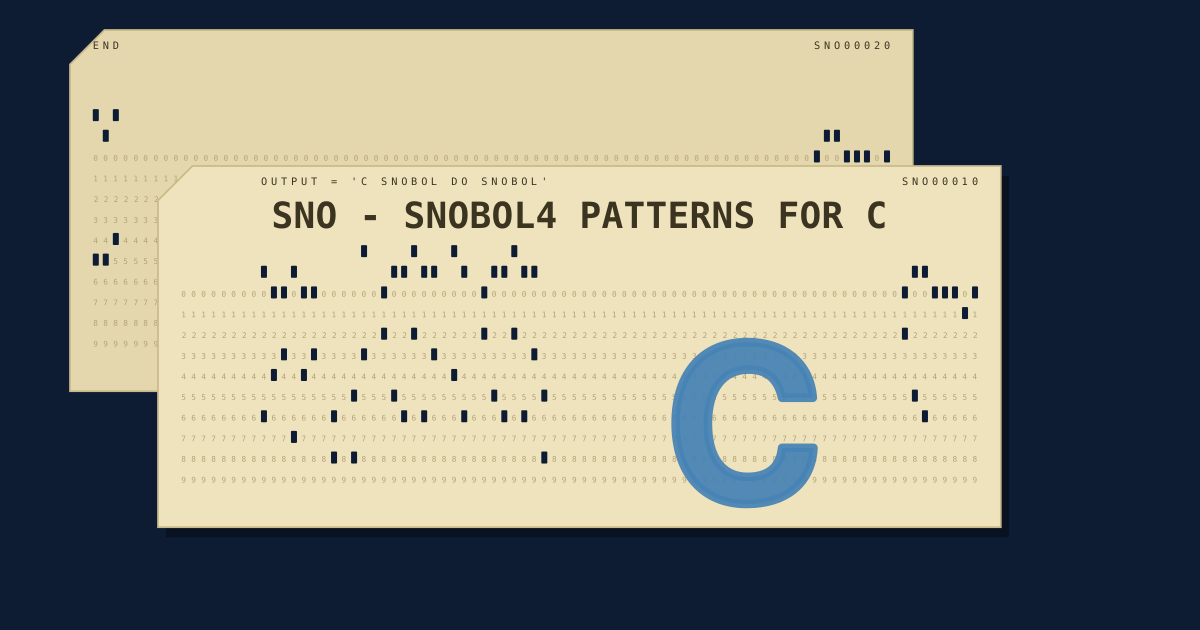
I've wanted to do this since 1988!
SNO is a small C99 library that brings the pattern matching of SNOBOL4 to C, as described in The SNOBOL4 Programming Language, 2nd edition, by R. E. Griswold, J. F. Poage and I. P. Polonsky (Prentice-Hall, 1971), better known as "The Green Book". The code is on GitHub [link to repo], and this post is the story of how it came to be the shape it is.
Where it started
I used SNOBOL at university and, quirks and all, parsing files with it was a breeze. However, and at the time, I loved C and wanted a C version of SNOBOL but the task was clearly a daunting one and so I carried on hand coding my parsing needs ad-hoc. (I still do love C btw warts and all!)
After decades of ad-hoc, but still SNOBOL inspired, C parsing using some ersatz and ultimately unsatisfying snobol-esque functions - the time has come to do the job "properly".
So the naive idea was: take the Green Book, work through it chapter by chapter, and turn each SNOBOL4 function into a C function. LEN becomes sno_len, ANY becomes sno_any, job done.
It was not job done. Almost every chapter turned up a place where SNOBOL and C disagree about something fundamental - what a string is, what failure is, what an error is, even what a column is. This post is about those clashes and how each one was resolved - the resolutions became the library.
A little history
SNOBOL was created at Bell Labs in the early 1960s by David Farber, Ralph Griswold and Ivan Polonsky; SNOBOL4 followed in 1967. It is often filed under "esoteric", which is unfair. It was a serious tool for text, and its patterns are more powerful than regular expressions: with recursive patterns and BAL they can match nested structures that no true regex can.
It was also a language of the 80-column punched card, and that shows everywhere once you look. TAB and POS take column numbers. &TRIM exists because every card was padded with blanks. INPUT reads records, and longer ones are truncated. Even the Green Book's examples are fixed-field data - chemical elements, and the 1964 list of congressmen from New Jersey.
The Green Book survives online thanks to the scan at regressive.org. Section numbers throughout the library (and its comments) refer to it.
When Worlds Collide!
The SNOBOL to C clashes and how they were resolved
Clash 1 - What is a string?
To SNOBOL a string is a value. To C it's a pointer and a promise that a '\0' is out there somewhere - the answer?...
The SNO library uses views: a half-open interval [begin, end) over characters someone else owns.
typedef struct {
    sno_cursor_t begin;
    sno_cursor_t end;    // one past the last char (exclusive)
} sno_view_t;
A view never owns or copies text and never includes a terminating '\0' (it may contain NUL bytes, though).
Clash 2 - Moving between worlds
sno_bind makes a view of a C string and sno_unbind copies one back into a buffer when C needs it.
When matching, the subject's begin is the cursor. A pattern function advances it on success and leaves it alone on failure. That's the whole scanner.
Clash 3 - The null string is not failure
In SNOBOL a statement can succeed with the null string "", or it can fail and take its :F branch. Those are different things, and C's NULL can't tell them apart, at least not by itself.
So, the SNO view as sno_view_t encodes both:
Table 1. Null string and failure
begin |
end |
made by | |
|---|---|---|---|
| null string | not NULL | == begin | sno_null(), sno_bind("") |
| failure | NULL | NULL | sno_fail() |
NB Every function accepts a failure view and passes failure on, so a chain of matches simply stops making progress when one of them fails.
This sounds obvious. Yet, I still managed to return sno_null() instead of sno_fail() from sno_any and spent a while wondering why "no match" was succeeding. The tests caught it, which is what they're for.
Clash 4 - Patterns are not functions and SNO does not backtrack
I used to like ARB but I probably over and inappropriately used it.
SNOBOL patterns backtrack. ARB matches nothing at first, and each time something after it fails, it grows by one character and tries again. A C function that has already returned can't be "backed into", so a stand-alone sno_arb would match the null string forever.
The first sketch was a recursive matcher with backtracking built in. It worked, but it wasn't C - it was an interpreter. So SNO does without implicit backtracking altogether: functions are greedy, commit on success, and chain by passing views. Alternatives are written by the caller with ordinary ||, saving and restoring the view.
The Green Book turns out to be on my side here. "SPAN never matches a string shorter than the maximum span," and when later components fail, "BREAK does not skip over the break character to continue streaming". SNOBOL itself doesn't backtrack into SPAN or BREAK.
ARB's uses can readily map onto BREAK, a literal search ("everything up to the next ;"), or a loop in the caller. The book itself advises against ARB for fields with known delimiters.
Clash 5 - Reading a line
INPUT is a SNOBOL variable - reading it reads a record. Its SNO equivalent sno_input is the function that took four rewrites to get right, because it's exactly where C strings and SNOBOL strings collide.
However, sno_input is where I learned the most about how SNO in C can model the semantics and, ultimately, the utility of SNOBOL:
- one call reads exactly one line - so a read loop always terminates
'\n'is not stored; the buffer is terminated, the view excludes the'\0'- an empty line is the null string but end of file is failure
- a final line without
'\n'is a normal line - a line longer than the buffer is truncated and the rest discarded - SNOBOL's record length, minus the card reader
Clash 6 - Errors are not failures
Failure means the text doesn't match whereas an error means the program is wrong.
ANY('') - a null set - is not a failure in SNOBOL. It's error 4, NULL STRING IN ILLEGAL CONTEXT, and the program stops.
My first instinct was to return failure; my second was assert - neither is right. Failure would make a bug look like a non-match, and assert vanishes with NDEBUG (I've complained about that before).
Chapter 10 of the Green Book settles it. SNOBOL's errors 1 to 16 are conditionally fatal: with the default &ERRLIMIT = 0 they terminate the program. So SNO's preconditions call sno_error(), which prints the Green Book's own message and exits with the error number:
ERROR 14 -- NEGATIVE NUMBER IN ILLEGAL CONTEXT
The error number becomes the DOS ERRORLEVEL, so every precondition can be tested from a batch file under DOSBox - which is a lot more satisfying than it has any right to be.
Table 2. SNO Errors
| condition | Green Book error |
|---|---|
null set to ANY, NOTANY, SPAN, BREAK |
4 NULL STRING IN ILLEGAL CONTEXT |
negative LEN, TAB, RTAB, RPOS |
14 NEGATIVE NUMBER IN ILLEGAL CONTEXT |
NULL FILE* |
12 ILLEGAL I/O UNIT |
| read error | 11 READING ERROR |
| C-only bad arguments (NULL buffers, subjects) | 10 ILLEGAL ARGUMENT TO PRIMITIVE FUNCTION |
Clash 7 - Identical, but not the same
IDENT(X,Y) in SNOBOL compares pointers. That works because SNOBOL stores each distinct string "once and only once", so equal strings share storage.
SNO views sno_view_t are not interned. Two views of "BCD" in different buffers have different pointers - so sno_ident compares content.
Copy SNOBOL's mechanism and you get the wrong answer but copy its meaning and you get the right one.
DIFFER is defined as the complement of IDENT, with one twist: in SNOBOL a failed argument means the function is never called, so in SNO both return false when either argument is a failure view.
Clash 8 - Columns and the punched card legacy
SNOBOL was built to work with 80 column punched cards and its functions and functionality are predicated on that fact. Not only is that fact an anachronism, it is also a problem for the implementation of the SNO library - a tricky one at that.
TAB(29) means "column 29". That needs to know where the subject started, and a view only knows its cursor and its end.
I tried adding the origin to the view, and then a separate cursor, and both cost every view, everywhere, 50% more size to help three functions.
When in doubt fall back to the ideas behind SNOBOL. Ergo, I want to parse lines of free-format text i.e. fields split by BREAK and SPAN, not by column. Columns were a punched-card feature.
Therefore, views stay two pointers and the consequences for tabbing:
RTABandRPOSmeasure from the end, which every view has - they work anywhere in a chainTABcounts columns of the view you give it - on a freshly read line that's column n; after other matches it's the same asLEN. For true columns,TABfrom a fresh copy of the linePOSisn't a primitive (every view is at its own column 0);sno_at(line, u)gives the cursor's column when you need it
Clash 9 - Returning true
SNOBOL predicates "return the null string if the condition is met and fail otherwise". There is no true or false - success is true.
The SNO library keeps that wherever it matters for chaining - a function that takes a subject returns a view - the matched view, or for a cursor test like RPOS a null string for true and sno_fail() for false.
However...
Functions that take no subject (sno_ident, sno_differ, sno_failed, sno_is_null) return bool, because they cross back into C semantics for the program itself.
Putting it all together
The Green Book's congressmen cards, in SNO (fields TABbed from a fresh copy of the line):
char buf[81];
sno_view_t card, u, name, po;

while (!sno_failed(card = sno_input(stdin, buf, sizeof buf))) {
    u = card; sno_tab(&u, 3);   name = sno_trim(sno_len(&u, 26));
    u = card; sno_tab(&u, 35);  po = sno_rem(&u);
    sno_output(stdout, name);
    // ...pad and output po...
}
N.B. a short card makes sno_len fail, sno_trim passes the failure on, and sno_output writes nothing - no checks needed in between. That's clash 3 (null versus failure) paying for itself.
Why not just use regex?
For a quick search, regex is shorter and you should indeed use it - but for parsing perhaps not?
The epiphany
Somewhere around clash 4 (backtracking) with SNOBOL as C functions, I realised that SNOBOL patterns with greedy, committing primitives and ordered choice are a Parsing Expression Grammar - this was formalised by Bryan Ford in 2004, and the model behind a good many modern parser generators.
In this way the SNO library evolved as a 2004 idea built out of a 1971 book, which is either very old or very new, depending how you look at it.
Where it's at
SNO is at v0.4. The string and I/O basics are done (BIND, UNBIND, INPUT, OUTPUT, SIZE, TRIM, IDENT, DIFFER), as are the first patterns (LEN, ANY, NOTANY, TAB, RTAB, REM) and the Green Book errors. Next come RPOS, then SPAN and BREAK - after which it can finally parse the p-code it was written for - and then BAL, with a twist: it takes the bracket pair as an argument, so [bx+si] balances as happily as (a+b).
Colophon
C99. Built with Open Watcom for 16-bit DOS (tiny model, .COM) and with gcc/clang on modern machines. Tested with plain assert.h, plus a DOS batch file that checks each precondition's ERRORLEVEL, under DOSBox. Written to parse the output of a Small-C compiler targeting the 8086 via p-code, assembled with A86.
The Green Book: Griswold, R. E., Poage, J. F. and Polonsky, I. P., The SNOBOL4 Programming Language, 2nd ed., Prentice-Hall, 1971 - scan at regressive.org.
The code: https://github.com/cspjst/SNO - MIT Licence.
I hope this has been of some use to anyone interested in these ideas.
† The header image is a real two-card SNOBOL4 deck, punched in IBM 029 card code. The first card is OUTPUT = 'C SNOBOL DO SNOBOL', with columns 1-8 left blank because a statement with no label must begin with a blank; the second card is END in column 1. Columns 73-80 carry the deck sequence numbers SNO00010 and SNO00020, which the compiler ignores (Green Book 10.1.1). Feed the deck through a SNOBOL4 compiler and it prints this post's title. ↩

No comments:
Post a Comment