Reading List

The Selfish Gene
The Psychopath Test: A Journey Through the Madness Industry
Bad Science
The Feynman Lectures on Physics
The Theory of Everything: The Origin and Fate of the Universe


ifknot's favorite books »
Showing posts with label active objects. Show all posts

Saturday, 10 September 2016

Migrating to Bitbucket and turning my markdown frown upside down with Dillinger WYSIWYG and Cloudup image drop spot.

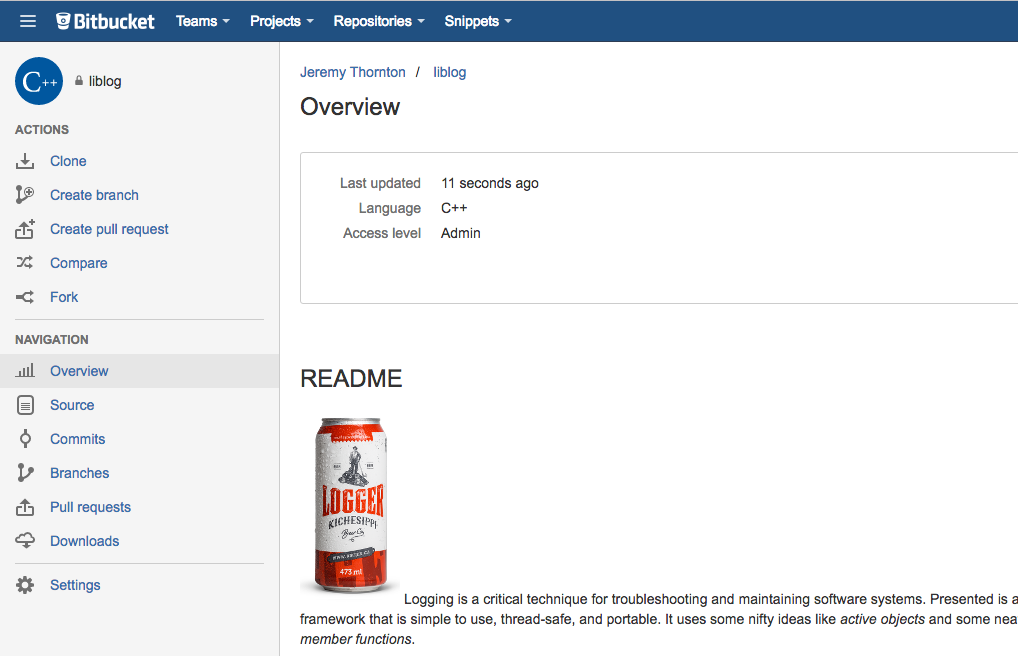
Check out my fancy markdown https://bitbucket.org/ifknot/liblog


Why move from GitHub to Bitbucket?


Bitbucket, similar to GitHub, is a web based GIT hosting service for your projects. It offers free private repositories with free private wikis on accounts of up to 5 users(!) and you can switch any repo public and back again anytime. So develop in private and publicise when you're ready. 

GitHub’s  free account doesn’t allow for private repos and their lowest paid option (for organizations) only allows up to 10 private repos. Bitbucket, on the other hand, offers unlimited private repos. 

It's easy to import directly from GitHub with the click of a button - well done Bitbucket.

What to move first?

I moved over liblog the logging software that I first blogged about way back in Jan 2014 but wanted to have a nice front piece for when I chose to make it public. This can be easily achieved using markdown in a README.md file pushed to the repo. 


Markdown frown. 

dillinger.io
Markdown is (quite) easy but slow to hand roll but with the excellent online WYSIWYG markdown editor Dillinger "Type some Markdown on the left... see HTML in the right" I found it pleasurable to work with and get some decent looking results.

Gratis image drop.

A free account on Cloudup gives you space to drop pics/vids/music/docs and have nifty short URLS to them for your markdown/blog/web

Saturday, 26 April 2014

A CSP approach to FBP Components: #3 RUN the livelock component #4 CHAOS the unpredictable component

Just because you're doing something doesn't mean everything is going well!


TL;DR The CSP process RUN represents livelock[1] and the entirely unpredictable mix of livelock and/or deadlock[2] is represented by the CHAOS process. Despite the difficulty in detecting these 2 worse case scenarios they are embodied as libfbp components.

The distributed deadlocked component that is failing to progress can be detected[2] by limiting the amount of time that a component will tolerate failing to progress. A much harder situation detect is one of livelock where a component will engage in any Information Package (IP) without making any meaningful progress. Harder still to detect is that chaotic component which can either engage in any IP or refuse to engage in any IP - it is in a superposition of livelock and deadlock!

Saturday, 19 April 2014

libfbp component interface

One Interface to rule them all, One Interface to find them,
One Interface to bring them all and in the Scheduler bind them
In the Land of Execution Models where the Programs lie.


TL;DR A PXM API for the libfbp PPM Components whereby; the underlying execution service can view each Component as an enqueuer of message requests[1] composed of C++11 function<void()> types behaving as functors[2]. 

The primary strategic goal here is that the libfbp implementation of Flow-Based Programming (FBP) as a Parallel Programming Model (PPM), though the FBP paradigm is a lot more more than simply a PPM, should be agnostic to its underlying Program eXecution Model (PXM) but must, never-the-less, provide an Application Programming Interface (API) that remains versatile in its implementation. 

Saturday, 22 March 2014

Part (2/2): Active Objects for Asynchronous Logging.


Contra-auguste Active Object

TL;DR It's just an slightly better (imho) implementation of Sutter's Dr. Dobbs 2010 articles [1][2]

As per Lavender & Schmidt's article[3] Sutter's implementation is a further refinement of the integrated scheduler variant of their original pattern removing, as it does, altogether the proxy and scheduler relying on direct message passing between client and scheduler. 

Indeed Sutter's scheduler (his Active class) contains the message queue as a private composition -which is too much integration. Too much because it forces the client to be aware of the scheduler which as an unnecessary, and avoidable, level of dependancy that binds the scheduler to the client.

The client need only be aware of the tail of the activation queue and, hence, the has-a-relationship with the message queue can be broken out of the scheduler for a more naturally component orientated approach that facilitates scheduler fungibility. Further, the scheduler need only be aware of the head of the activation queue.

Monday, 17 March 2014

Part (3/3): A general purpose thread-safe internally synchronized message queue.

Proxies: Who's wearing the trousers? 

TL;DR I want to be able to do this:

producer_active_object(enqueuer_proxy(concurrent_queue));
consumer_active_object(dequeuer_proxy(concurrent_queue));

Today' reference will mostly be:
The proxy pattern[1] provides restricted or modified access to hidden or protected resources. There are a few subsets of proxies:
  • remote proxy
  • virtual proxy
  • protection proxy
  • smart reference
The kind of proxy that the message_queue type needs is combination of the last 2 that offers:
  • Access to the head and tail of the message queue via its various private enqueue and dequeue member functions.
  • Counting the number of references to the message queue and closing it down when either there are no more interested consumer(s) or the producer(s) have finished producing. 
Okay so the design choices are to either:
  1. Have a zoo of some_message_queue types each with member functions for generating their own proxies that use the extremely useful friendship C++ language feature[2]
  2. Select a specific some_message_queue policy from the zoo and wrap it in a generic message_queue type which dishes out the head and tail proxies.
Well at least there is no goat in this problem so in true Monty Hall style 
"Let's see what's behind door number 2..." 

Wednesday, 5 March 2014

Part (2/3): A general purpose thread-safe internally synchronized message queue.

When it's time to end the relationship.

So here is the code for the single lock general purpose message queue as the obviously correct base queue type, but with one important addition...

The ability to close() the message queue.

But why?

TL;DR github.com/ifknot/libfbp

Sunday, 23 February 2014

Part (1/2): Active Objects for Asynchronous Logging.

Asynchronous physical humour 

In his 2010 Dr Dobbs article[1] Herb Sutter espouses
"Prefer Using Active Objects Instead of Naked Threads"
The laudability of this is derived from Sutter's 2009 and 2007 observations[2],[3] that
"Use Threads Correctly = Isolation + Asynchronous Messages" 
(N.B. It is fascinating to read Sutter's 2009[2] & 2007[3] similarities to Sir Tony Hoare[6] 1978 seminal work on Communicating Sequential Processes(CSP)[7] and J. Paul Morrison[8] 1970s original ideas on Flow-Based Programming(FBP)[9] but more of this later...)

TL;DR Think you can walk-the-walk? You don't know Jack about thread programming if you haven't read [3], [2] & [1]